
As healthcare facilities across the United States work to maintain safe staffing ratios while controlling operational costs, understanding the financial impact of flexible staffing models is essential. Per diem nurse staffing offers critical agility during census spikes, employee absences, and seasonal fluctuations — but it requires thoughtful financial planning.
Without a structured budgeting approach, per diem usage can feel unpredictable. With proper planning, however, it becomes a powerful tool for workforce stability and cost efficiency.
In this per diem nurse staffing guide, you'll learn about per diem nursing rates for healthcare facilities, understand common per diem staffing expenses, and discover practical strategies for effective healthcare staffing cost control.
Understanding Per Diem Nurse Staffing Costs
Per diem nurses are hired on an as-needed basis, typically receiving higher hourly wages in exchange for schedule flexibility and lack of traditional benefits. While they help avoid the long-term financial commitment of full-time hires, their cost structure differs significantly.
To plan effectively, facilities must understand both direct and indirect expenses.
Key Factors Influencing Per Diem Nurse Staffing Cost
1. Hourly Rates
Per-diem nurses generally earn higher hourly wages than full-time staff. This premium reflects:
Schedule flexibility
Lack of benefits
Short-notice availability
Market demand
Rates vary depending on:
Geographic region
Facility type (hospital vs. long-term care)
Nurse experience level
Shift timing (night, weekend, holiday)
Urban facilities typically face higher rates due to competitive labor markets. Understanding local per diem nursing cost rates for facilities is the first step toward accurate budgeting.
2. Specialty Skills and Certifications
Nurses with advanced certifications or specialty expertise command higher rates. For example:
ICU and critical care nurses
Operating room nurses
Emergency department nurses
NICU or pediatric specialists
Behavioral health specialists
If your facility frequently requires specialized coverage, this should be reflected in budget projections.
3. Regional Market Conditions
Labor market conditions significantly influence rates.
Factors include:
State nursing shortages
Cost of living
Competition among healthcare systems
Local union agreements
Conducting regional market research ensures realistic financial planning.
Breaking Down Per Diem Staffing Expenses
Beyond hourly wages, several additional costs must be considered when calculating total per diem staffing expenses.
Agency Fees
If working with a staffing agency, bill rates typically include:
Nurse wages
Payroll taxes
Insurance coverage
Administrative overhead
Agency profit margin
Clarify what is included in the hourly rate to avoid surprises.
Overtime and Shift Differentials
Per diem shifts may include:
Overtime premiums
Night differentials
Weekend differentials
Holiday rates
Incorporate these variations into projected costs.
Onboarding and Orientation
Even temporary staff require:
Facility orientation
EHR training
Compliance instruction
Policy reviews
While these costs may be smaller than full-time onboarding, they still impact the budget.
Administrative and Scheduling Costs
Internal staff time spent coordinating:
Shift approvals
Documentation
Credential verification
Invoice reconciliation
These indirect costs should be acknowledged when calculating total staffing expenses.
How to Plan Your Budget for Per Diem Staffing
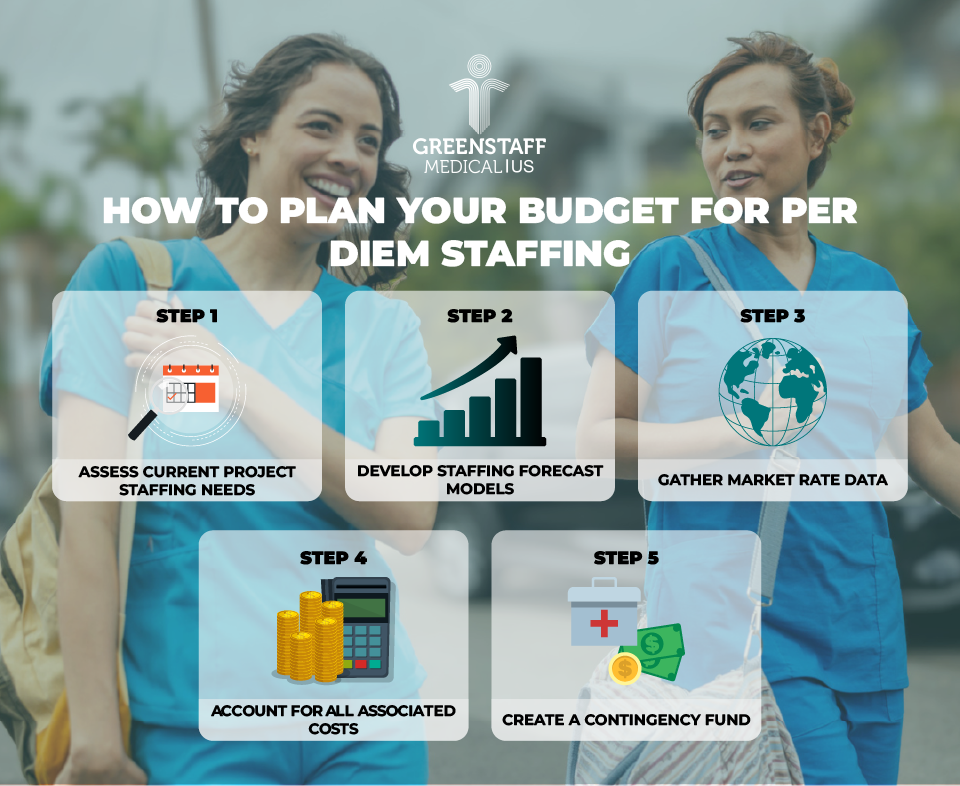
A structured approach to budgeting transforms per diem staffing from reactive spending into strategic planning.
Step 1: Assess Current and Projected Staffing Needs
Begin by analyzing:
Historical census trends
Average sick call frequency
Seasonal spikes (flu season, holidays)
Known upcoming leave (maternity, medical, PTO)
Create projections for both typical and high-demand scenarios.
Step 2: Develop Staffing Forecast Models
Use historical data to calculate:
Average number of per diem shifts per month
Department-specific usage trends
Average bill rate per nurse
Build scenario-based projections, such as:
Normal operations
10% census increase
Emergency surge conditions
This ensures financial preparedness.
Step 3: Gather Market Rate Data
Contact multiple staffing agencies to compare:
Standard hourly bill rates
Specialty premiums
Overtime structures
Volume discounts
Understanding the competitive landscape helps control costs while maintaining quality.
Step 4: Account for All Associated Costs
When planning your healthcare staffing cost control strategy, include:
Agency bill rates
Differential pay
Onboarding time
Administrative coordination
Replacement guarantees
Comprehensive budgeting reduces financial surprises.
Step 5: Create a Contingency Fund
Healthcare demand is unpredictable.
Establish a staffing contingency reserve to cover:
Unexpected census spikes
Emergency coverage needs
Outbreak situations
Multiple simultaneous call-outs
A dedicated reserve protects financial stability.
Cost Control Strategies for Per Diem Staffing
Once your budget is in place, proactive management ensures expenses remain controlled.
1. Build Long-Term Agency Partnerships
Strong relationships often lead to:
Preferred pricing
Volume-based discounts
Priority shift fulfillment
Improved communication
Negotiation becomes easier when partnerships are consistent.
2. Monitor Usage Patterns Monthly
Track:
Total per diem hours
Overtime savings
Department-level usage
Cost per patient day
Data-driven decisions strengthen financial oversight.
3. Balance Per Diem and Core Staffing
Over-reliance on per diem staff can inflate costs.
Aim for:
A stable core workforce
Supplemental per diem support
Reduced overtime dependency
A balanced approach improves sustainability.
4. Optimize Scheduling Efficiency
Avoid last-minute premium rates by:
Forecasting demand early
Posting shifts in advance
Encouraging internal coverage first
Proactive scheduling reduces premium charges.
5. Evaluate Agency Performance Regularly
Assess agencies based on:
Fill rate
Nurse quality
Response time
Compliance accuracy
Invoice transparency
If performance does not justify cost, explore alternative partners.
Comparing Per Diem Costs to Other Staffing Models
Understanding relative cost positioning helps inform decision-making.
Per Diem vs Overtime
While per diem rates are higher hourly, they often cost less than:
Overtime premiums (time-and-a-half or double-time)
Burnout-related turnover costs
Error-related liability risks
Reducing overtime protects both budgets and staff well-being.
Per Diem vs Travel Nurses
Travel nurses typically involve:
Housing stipends
Travel reimbursements
Long-term contract guarantees
Per diem staffing is often more cost-effective for short-term coverage.
Per Diem vs Full-Time Hires
Full-time nurses involve:
Benefits packages
Paid time off
Retirement contributions
Ongoing training investments
Per diem staffing offers financial flexibility during fluctuating census periods.
Measuring Return on Investment (ROI)
Per diem staffing should be evaluated not only by cost, but by overall impact.
Track metrics such as:
Overtime reduction percentage
Staff satisfaction scores
Patient satisfaction metrics
Turnover rates
Cost per discharge
A strong ROI justifies continued use.
Long-Term Financial Strategy
Per diem staffing works best as part of a broader workforce plan.
Combine:
Full-time core teams
Internal float pools
Strategic per diem partnerships
Workforce analytics tools
Integrated planning enhances financial predictability.
Final Thoughts
Understanding per diem nurse staffing cost is essential for facilities seeking both clinical excellence and financial sustainability. While per diem staffing carries higher hourly rates, it often reduces overall labor expenses when strategically deployed.
By carefully evaluating per diem nursing rates for facilities, forecasting staffing needs, accounting for hidden costs, and implementing proactive healthcare staffing cost control measures, facilities can turn flexible staffing into a long-term operational advantage.
Budget planning is not just about controlling expenses — it’s about ensuring consistent, high-quality patient care without financial strain.
For reliable, flexible staffing support tailored to your facility’s needs, consider partnering with Greenstaff Medical US. Our team provides transparent pricing, high-quality per-diem professionals, and responsive service designed to support your workforce’s goals. Contact us today to learn how we can help you build a sustainable staffing strategy that balances cost efficiency with exceptional patient care.