
Healthcare facilities across the United States are under constant pressure to maintain safe staffing ratios, control labor costs, and ensure high-quality patient care. As workforce shortages persist and patient volumes fluctuate, administrators must adopt flexible and sustainable staffing strategies.
Two commonly used models are per diem nurse staffing models and internal float pools. Both approaches aim to solve coverage gaps, but they differ significantly in structure, cost, flexibility, and long-term impact.
So, which works best?
The answer depends on your facility’s operational needs, financial structure, and patient population. This guide breaks down both strategies in detail to help you make an informed decision.
Understanding Per Diem Nurse Staffing
Per diem nurse staffing involves hiring nurses on an as-needed basis to fill temporary gaps. These professionals are typically employed through staffing agencies or maintain flexible working arrangements that allow them to accept shifts based on availability.
Per diem nurses are commonly used to:
Cover call-outs
Fill last-minute vacancies
Manage seasonal spikes
Support high-acuity departments
Reduce overtime strain
Unlike full-time employees, per diem nurses are not typically entitled to benefits such as health insurance or paid time off, making them a variable labor cost rather than a fixed one.
Benefits of Per Diem Nurse Staffing
1. Maximum Flexibility
One of the strongest advantages of per diem staffing is flexibility. Facilities can scale staffing levels up or down quickly in response to patient census changes.
This is particularly useful for:
Emergency departments
Seasonal illness surges
Short-term staffing shortages
Facilities with unpredictable admission rates
2. Rapid Coverage
Per diem staffing agencies often maintain large, pre-vetted nurse pools. This allows facilities to secure coverage on short notice, sometimes within hours.
This responsiveness reduces:
Unit understaffing
Mandatory overtime
Workflow disruptions
3. Access to Specialized Skills
Facilities can request nurses with specific certifications or experience, such as:
ICU
OR
NICU
Behavioral health
Dialysis
This targeted access avoids the need to permanently hire specialized staff when demand is temporary.
4. Variable Cost Structure
Although per diem nurses typically command higher hourly wages, facilities avoid:
Benefits costs
Long-term employment commitments
Paid leave expenses
For short-term or irregular needs, this can be financially efficient.
Understanding Internal Float Pools
An internal float pool, often called a hospital float pool strategy, consists of nurses directly employed by the healthcare facility who are cross trained to work across multiple units.
These nurses are:
Permanent employees
Familiar with facility systems
Trained for multi-department coverage
Float pool nurses' step in during staff shortages or high census periods while remaining within the organization.
Benefits of an Internal Float Pool Strategy
1. Organizational Familiarity
Float pool nurses already understand:
Hospital policies
EHR systems
Clinical protocols
Leadership structure
Organizational culture
This reduces onboarding time and improves workflow continuity.
2. Stronger Team Cohesion
Because float nurses are part of the internal workforce:
Communication tends to be smoother
Team trust is stronger
Collaboration improves
Team integration can enhance morale and reduce friction.
3. Faster Unit Integration
Since float pool nurses are trained across departments, they can transition quickly without extensive reorientation.
This increases efficiency during urgent staffing needs.
4. Greater Operational Control
Facilities maintain:
Direct oversight
Scheduling authority
Performance management
Professional development
This allows stronger alignment with quality standards and long-term goals.
Cost Comparison: Per Diem vs. Internal Float Pools
Understanding financial implications is crucial when evaluating per diem staffing vs float pool strategies.
Per Diem Nurse Staffing Costs
Advantages:
No benefits expenses
No long-term payroll obligations
Flexible usage based on need
Considerations:
Higher hourly rates
Agency markups
Premium pay for last-minute shifts
Per diem works well when demand is inconsistent.
Internal Float Pool Costs
Advantages:
Predictable staffing structure
Lower hourly base rates
Stronger integration
Considerations:
Salary commitments
Benefits packages
Ongoing training costs
Paid time off
Float pools represent fixed labor costs, regardless of census variability.
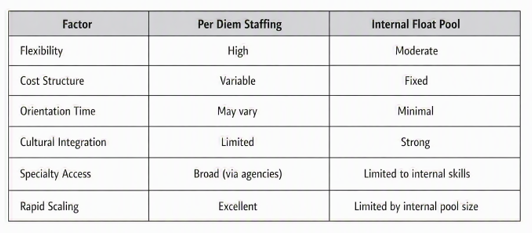
Operational Comparison
When Per Diem Nurse Staffing Works Best
Per diem staffing is ideal when:
Census fluctuates frequently
Staffing needs are unpredictable
Budget flexibility is required
Specialized skills are occasionally needed
Reducing overtime is a priority
Facilities experiencing sudden surges benefit significantly from the scalability of this model.
When Internal Float Pools Work Best
Float pools are more effective when:
Patient volumes are relatively stable
Long-term staffing control is preferred
Culture consistency is critical
Investment in workforce development is a priority
Administrative oversight is centralized
Facilities with predictable needs often maximize efficiency through structured float programs.
Hybrid Model: The Strategic Middle Ground
Many healthcare systems adopt a hybrid model combining both strategies.
For example:
Internal float pool handles predictable coverage
Per diem staffing fills unexpected gaps
Agencies provide specialty support
This layered approach offers both stability and flexibility.
Key Decision Factors to Consider
1. Patient Volume Trends
Analyze historical data to determine whether fluctuations are:
Seasonal
Sporadic
Predictable
Growth-related
Highly variable census favors per diem models.
2. Financial Structure
Assess whether your budget supports:
Fixed labor commitments (float pool)
Variable cost flexibility (per diem)
A thorough cost analysis helps clarify the best approach.
3. Workforce Morale
Consider staff feedback:
Do full-time nurses feel overworked?
Is there resistance to floating between units?
Is overtime a persistent issue?
Workforce sentiment can guide strategy selection.
4. Recruitment Environment
In tight labor markets, building a large internal float pool may be difficult. Per diem partnerships may offer broader talent access.
Risk Considerations
Per Diem Risks
Inconsistent familiarity with facility protocols
Potential variation in nurse quality
Dependency on external agencies
Float Pool Risks
Limited scalability
Potential burnout among float staff
Fixed costs during low census periods
Each model carries trade-offs that must be managed carefully.
Long-Term Strategic Planning
Staffing strategies should align with:
Organizational growth plans
Budget forecasts
Patient population trends
Regulatory compliance requirements
Facilities that review staffing data quarterly are better positioned to adjust proactively.
Final Verdict: What Works Best?
There is no universal answer.
If your facility experiences unpredictable surges and fluctuating demand, per diem nurse staffing models offer unmatched flexibility.
If your organization prioritizes stability, cultural cohesion, and long-term workforce investment, an internal float pool may deliver greater consistency.
For many facilities, the most effective solution is a balanced hybrid approach that integrates both.
Conclusion
Both per diem nurse staffing models and internal float pools play essential roles in modern healthcare workforce planning. The right choice depends on your facility’s census trends, financial priorities, workforce culture, and long-term strategic goals.
By carefully evaluating operational needs, cost structures, and patient care requirements, healthcare leaders can implement a staffing strategy that enhances efficiency, protects staff well-being, and maintains high-quality clinical outcomes.
Call to Action
For expert guidance on flexible and reliable staffing solutions, contact Greenstaff Medical US. Our team specializes in customized nurse staffing strategies designed to support your facility’s unique operational demands.
Reach out today to explore how we can help you optimize workforce performance while maintaining the highest standards of patient care.