
The allied health sector is the backbone of the American healthcare system. Comprising approximately 60% of the entire healthcare workforce, allied health professionals provide the diagnostic, technical, therapeutic, and support services that are critical to patient outcomes.
Allied health salaries in the U.S vary widely by specialty, experience, location, and work setting, with many in-demand roles offering strong earning potential—especially in travel, home health, imaging, rehabilitation, and high-acuity hospital environments. Whether you are a Physical Therapist, a Radiologic Technologist, or a Medical Laboratory Scientist, your earning potential is influenced by a complex web of factors.
In this guide, Greenstaff Medical breaks down the current salary landscape by specialty, location, and work setting to help you navigate your career and maximize your value.
1. Salary Analysis by Specialty
While passion for patient care is the primary driver for many, understanding the financial trajectory of your specialty is essential for long-term planning. Salaries in allied health often correlate with the level of education required and the technical complexity of the role.
Rehabilitation Services (PT, OT, SLP)
Rehabilitation remains one of the highest-paying branches within allied health due to the doctoral and master’s level requirements.
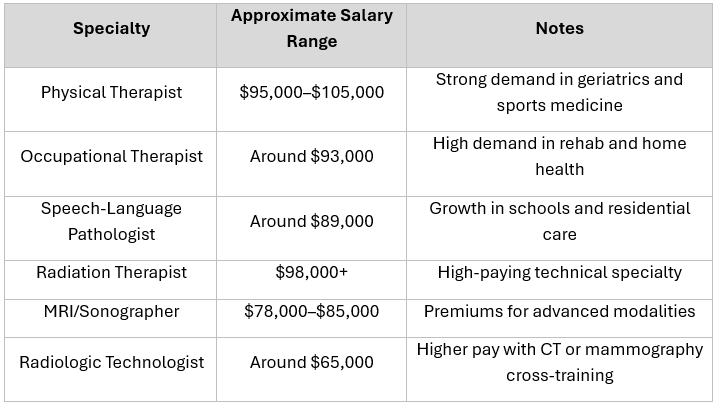
Physical Therapists (PT): With a median salary ranging from $95,000 to $105,000, PTs remain in high demand, particularly in geriatric care and sports medicine.
Occupational Therapists (OT): OTs see similar figures, often averaging around $93,000 annually.
Speech-Language Pathologists (SLP): SLPs are seeing rapid growth in schools and residential care, with median earnings near $89,000.
Diagnostic Imaging and Radiation
The demand for imaging professionals is skyrocketing as technology advances.
Radiation Therapists: These specialists are among the top earners in the technician category, often exceeding $98,000 due to the high level of precision and risk management involved in oncology.
MRI and Diagnostic Medical Sonographers: These roles typically earn between $78,000 and $85,000. Specializing in cardiovascular or neuro-sonography often commands a premium.
Radiologic Technologists: The entry point for imaging, "Rad Techs" average around $65,000, but those who cross-train in CT or Mammography see immediate salary boosts.
Laboratory and Cardiac Sciences
Medical Laboratory Scientists (MLS): Generally earning between $60,000 and $75,000, the value of lab professionals was highlighted during the pandemic and continues to rise as diagnostic testing becomes more personalized.
Cardiovascular Technologists: Specializing in the heart and lungs, these professionals earn a median of $63,000 to $70,000, with those in the "Cath Lab" often earning significantly more through on-call pay.
2. The Impact of Work Setting
Where you work is often just as important as what you do. Two professionals with the same degree can have a salary variance of 20% or more based purely on the facility type.
Outpatient Care Centers and Home Health
Surprisingly, some of the highest salaries for therapists (PT/OT) are found in home health care. Because these roles require significant travel and independence, agencies offer premium rates to attract talent.
Home Health: Often pays 10–15% more than traditional outpatient clinics.
Outpatient Centers: Offer high stability and predictable hours but may have slightly lower base salaries than acute care.
General Medical and Surgical Hospitals
Hospitals are the most common employer for allied health professionals. While the base salary is competitive, the real financial benefit in a hospital setting comes from differentials. Night shifts, weekend shifts, and "PRN" (pro re nata) roles can increase an annual take-home pay by $5,000 to $15,000.
Skilled Nursing Facilities (SNFs)
SNFs often offer higher starting salaries for therapists and assistants because the productivity requirements are higher. For those looking to maximize their hourly rate early in their career, SNFs are a frequent choice.
3. Geographic Location: Where is the Demand?
Cost of living and state-specific demand are massive drivers for allied health pay.
The West Coast: States like California and Washington consistently lead the nation in allied health pay. A Physical Therapist in California may earn 25% more than the national average, though this is often balanced by a higher cost of living.
The Northeast: New York, Massachusetts, and New Jersey offer robust salaries, particularly within large academic medical systems.
The "Traveler" Advantage: For many allied health professionals, the highest earning potential isn't found in a single location, but in moving between them. Travel allied health contracts—facilitated by agencies like Greenstaff Medical—often offer stipends for housing and meals that can effectively double a professional's net income compared to a permanent staff role.
4. How to Maximize Your Earning Potential
To move into the upper quartiles of the salary brackets, consider the following strategies:
Niche Certifications: Whether it’s a CHT (Certified Hand Therapist) for OTs or a specialty in Pediatric Advanced Life Support (PALS) for Respiratory Therapists, certifications prove expertise and justify higher pay. The same is true for respiratory therapist salary offers, where specialty credentials can change the rate fast.
Cross-Training: In imaging, the more "modalities" you know (X-ray, CT, MRI), the more indispensable—and expensive—you become to an employer.
Step into Leadership: Moving from a clinical role to a Lead Tech, Department Manager, or Rehab Director position typically adds $20,000+ to an annual salary.
Explore Travel Assignments: If you have the flexibility, travel allied health is the most immediate way to increase your income while exploring the country.
Conclusion
The allied health field is not just a path of service; it is a path of significant financial opportunity. By strategically choosing your specialty, remaining open to high-demand work settings like home health, and considering the benefits of travel contracts, you can build a career that is both rewarding and lucrative.
At Greenstaff Medical, we specialize in connecting allied health professionals with the highest-paying opportunities across the U.S. Whether you are looking for a permanent home in a top-tier hospital or your next great travel adventure, our recruiters are here to help you get the compensation you deserve.
Are you ready to see what your skills are worth in today's market? Explore our Allied Health Job Board or contact a Greenstaff recruiter today!